Restore app data from backup
Backup and restore isn’t available in the Atlassian Government environment.
Using Amazon S3 for storing backups is no longer available, except for customers who've used it in the past.
Perform a restore whenever you need to recover lost or damaged data in Jira or Confluence. You can restore backups that were taken within the last 30 days.
Limitations
You can only restore backups to apps that are empty and contain no user-generated data. If your organization has activated units, the destination must also have no customer data in the unit-scoped platform apps in scope (starting with Assets). This is evaluated as 'empty supported apps.' A destination that already contains data in any of these apps is not offered as a valid restore target. Make sure that the app you’re restoring to doesn’t have any data. We recommend restoring backups to a newly provisioned app.
For Confluence, delete all spaces (including personal spaces) and permanently remove them from the trash.
For the Jira family of apps, delete all associated data and empty the deleted data from trash. This includes deleting Jira Service Management spaces, asset schemas, and help centers.
You can only restore backups into apps that are available in the same organization.
Backups of deactivated apps are available for 30 days after the apps are deactivated.
After you restore data, new page IDs may get generated for Confluence page which may results in broken links. More about how to fix links
If your organization has activated units, you have to restore the backup to a separate, empty destination unit within the same organization — never to the unit it came from. Cross-region restores are not supported: the source and destination must be in the same data residency region.
Restore a backup
When you are restoring a backup, we recommend that you don’t open the app as this may create spaces that interfere with the restore operation.
Who can do this?
|
To restore a backup:
Go to admin.atlassian.com. Select your organization if you have more than one.
Select Data management, then Backup and restore.
Select Restore a backup.
Select the app you need to restore.
Select a backup from the list. Backups taken in the last 30 days are listed. If your organization has activated units, the backup list shows backups scoped to the units you are managing.
Review the backup details. If the backup includes attachments, users and groups, or personal spaces, select whether you want to restore them. Then, select Next.
Select where to restore the app data. If you don’t see any apps, it’s because of two reasons:
You can only restore a backup into an app that doesn’t contain any data. Select the Contain data filter and select No.
You can restore data to an app that’s on the same region as the backed-up app. You cn restore data to an app that’s on the same region as the backed-up app.
Note:
If your organization has activated units, the destination picker shows eligible destination units. Use the 'Contain data' filter to find empty units. Destinations that fail the emptiness check (for example, contain data in the 1P app or unit-scoped platform apps like Assets) are marked as ineligible.
If your organization has activated units, you will see eligible destination units (production or sandbox units) that are empty and within the same organization.
Select Next.
Before confirming, review the restore summary carefully.
For units-activated organizations, the summary shows: the source unit and backup date, the apps being restored, and whether Assets is included or excluded. On Premium, if Assets is listed as 'excluded,' this is expected behavior — see 'Assets during a restore' in this article.Validate data by checking if there could be potential problems before and after you restore. Resolve any problems.
If you are asked to delete data related to Jira Service Management, it includes deleting Jira Service Management projects, Assets schemas, and help centers.
Review the data to restore, then select Restore. Once the restore starts running, it’s added to the Restore table.
After the restore
After the restore completes, validate that all expected data is present in the destination. For Enterprise with units activated, verify that both your app data and Assets data are present in the destination unit. For Premium with units activated, verify that your Jira, Jira Service Management or Confluence data is present on the Sandbox site; note that Assets remains on your production site unless you opted in to the support-assisted path. If you notice discrepancies, contact Atlassian support.
Restoring with units
If your organization has activated units, you have to restore the backup to a separate, empty destination unit within the same organization. In-place restores and same-unit restores are not supported.
Enterprise: Restore into an empty app on an empty unit. The destination has its own Assets instance and other platform apps; these must also be empty.
Premium: Your Production and Sandbox share a single unit. Restores target a Sandbox site. Assets is excluded from the restore by default. If you need Assets restored, you opt in to a support-assisted path that provisions an isolated, site-level Assets instance on the Sandbox.
Only administrators with authority over both the source backup's unit and the destination unit can perform the restore.
Assets during a restore
Backup scope and restore scope can differ. Capturing Assets in a backup does not mean it is included in every restore.
For a supported restore into a separate destination unit, Assets is restored into the destination’s eligible, empty Assets instance.
For the supported shared-unit Sandbox path, Assets is excluded by default. You can restore the supported app data without changing production Assets or opening a support request.
Include Assets through Support
Contact Atlassian Support and identify the backup, destination Sandbox, and Assets data you need restored.
Support checks eligibility and explains the effect of preparing an isolated, site-level Assets instance.
Review any impact to existing Sandbox Assets data and confirm whether Support should proceed.
Wait for Support to confirm the destination is ready.
Return to Backup and Restore and retry the restore with Assets included.
The isolated Assets instance can be reused for later restores. It must be empty before another Assets restore; existing data is not silently overwritten.
Review app access for restored groups
App access controls which apps your groups and users have access to, with app's admin access granted separately. We restore app access but we don’t apply it without your confirmation, because it affects billing. More about app access in cloud
To review app access:
You’ll see a notification asking you to review app access.
Approve app access.
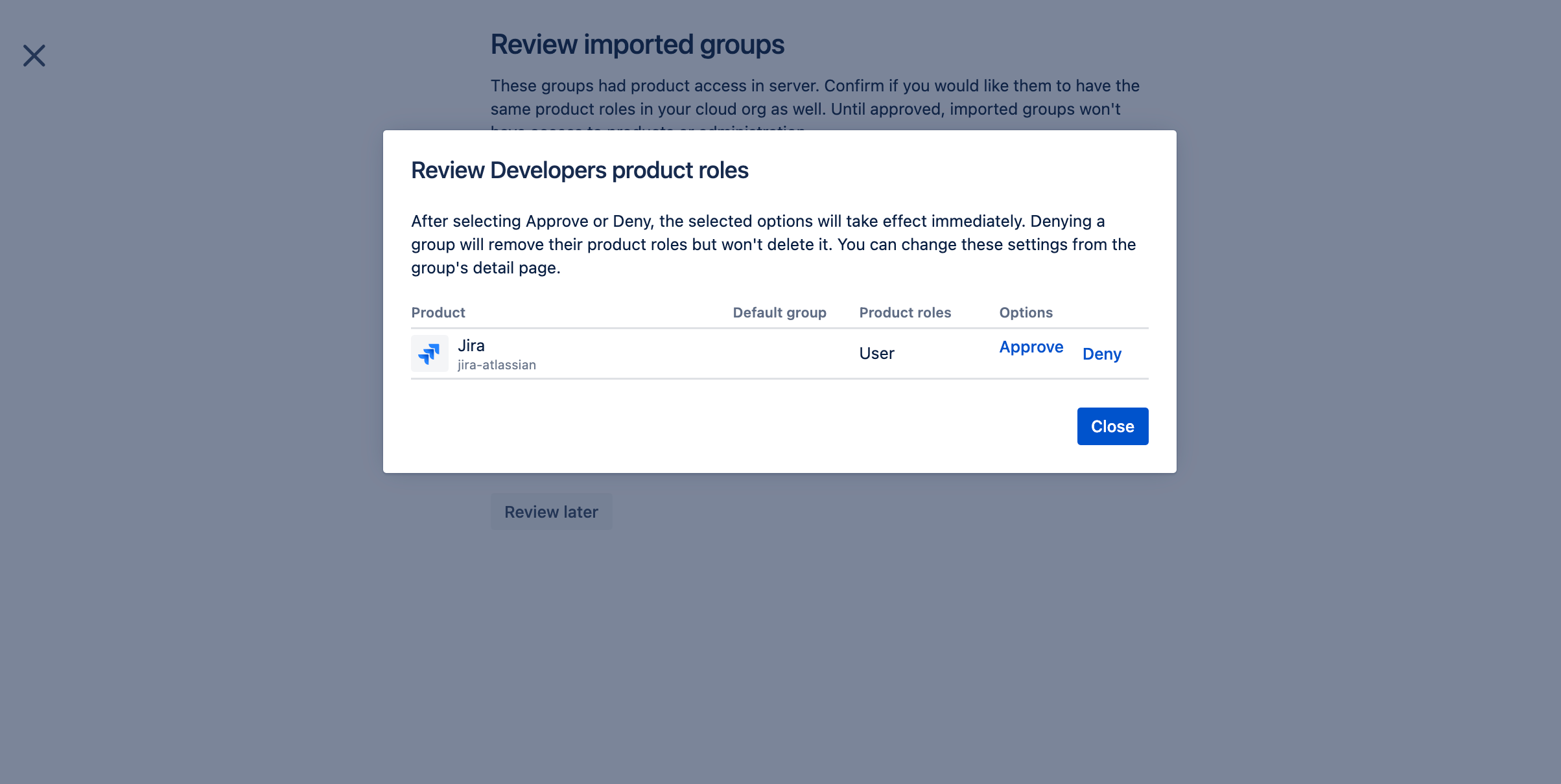
Grant or revoke access later on
To learn how you can grant or revoke app access later on, see the following page.
Was this helpful?