Mapping Jira Service Management Ticket Priorities with Opsgenie/Operations Alert Priorities
Platform Notice: Cloud Only - This article only applies to Atlassian apps on the cloud platform.
Summary
In JSM Opsgenie/Operations, when an integration sends a priority value, it's mapped to known levels: P1–P5. If the value matches, the alert is created with that priority. If it doesn't (e.g., "CRITICAL"), the alert defaults to P3.
This article offers a workaround to set the Operations/Opsgenie alert priority based on the appropriate priority of the JSM issue. See also JSDCLOUD-9565 - Priority mapping between Opsgenie and Jira Service Management
Solution
To map integration priorities to Opsgenie/operations, you would need to define a separate "Create Alert" action for each priority level in the integration. In these actions, set the filter to identify specific priority keywords and manually set the corresponding Opsgenie/operations priority value in the alert priority field.
To configure priority in alert creation and processing rules of Syncs:
Go to the team’s Operations page by selecting Go to Operations on the team’s profile.
Select Syncs from the sidebar. You can view the team syncs that have already been created, if any.
Under Alert creation and Processing rules > select Add rule
Enter Rule name > Select Create alert as the Rule type.
Add a condition to match one of the priority levels and manually set the priority
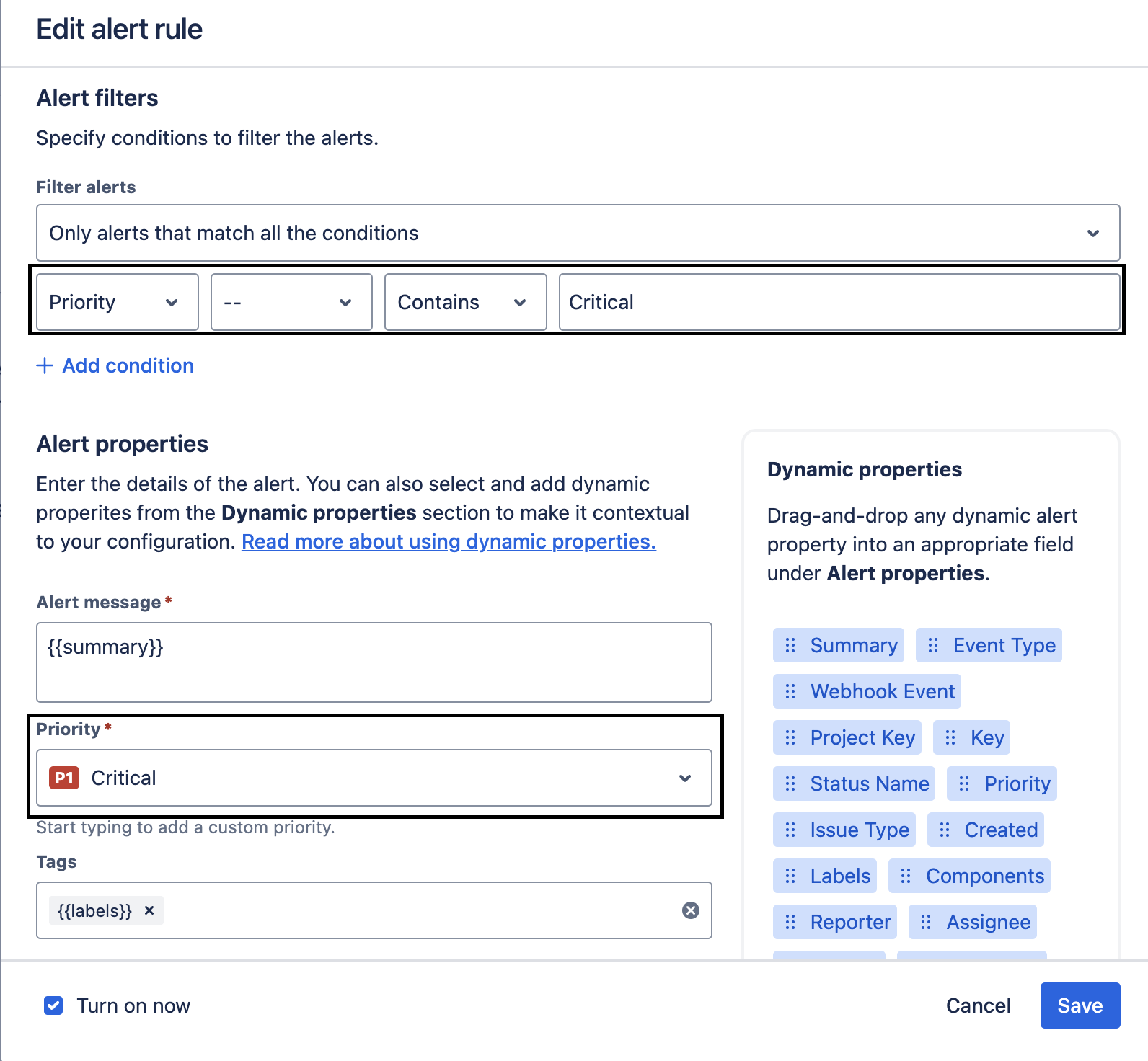
Select Save to add the rule.
Repeat steps 4-6 for each level of priority.
After configuring all priority-level rules, trigger a test sync from each Jira Service Management priority level and confirm that the resulting Opsgenie/Operations alert priority matches the intended mapping for each level, not just the one used when building the rule.
Because each priority mapping is a manually created rule, any future change to your JSM priority scheme (renaming or adding priority levels) requires updating these rules as well — they won't automatically pick up new priority values.
Was this helpful?